
IRS Form 4180
Report of Interview with Individual Relative to TFRP
Form 4180 is the IRS interview used to identify individuals personally responsible for unpaid trust-fund payroll taxes under the Trust Fund Recovery Penalty.
- Form
- Form 4180
- Who files
- Owners
- Last reviewed
- 2025
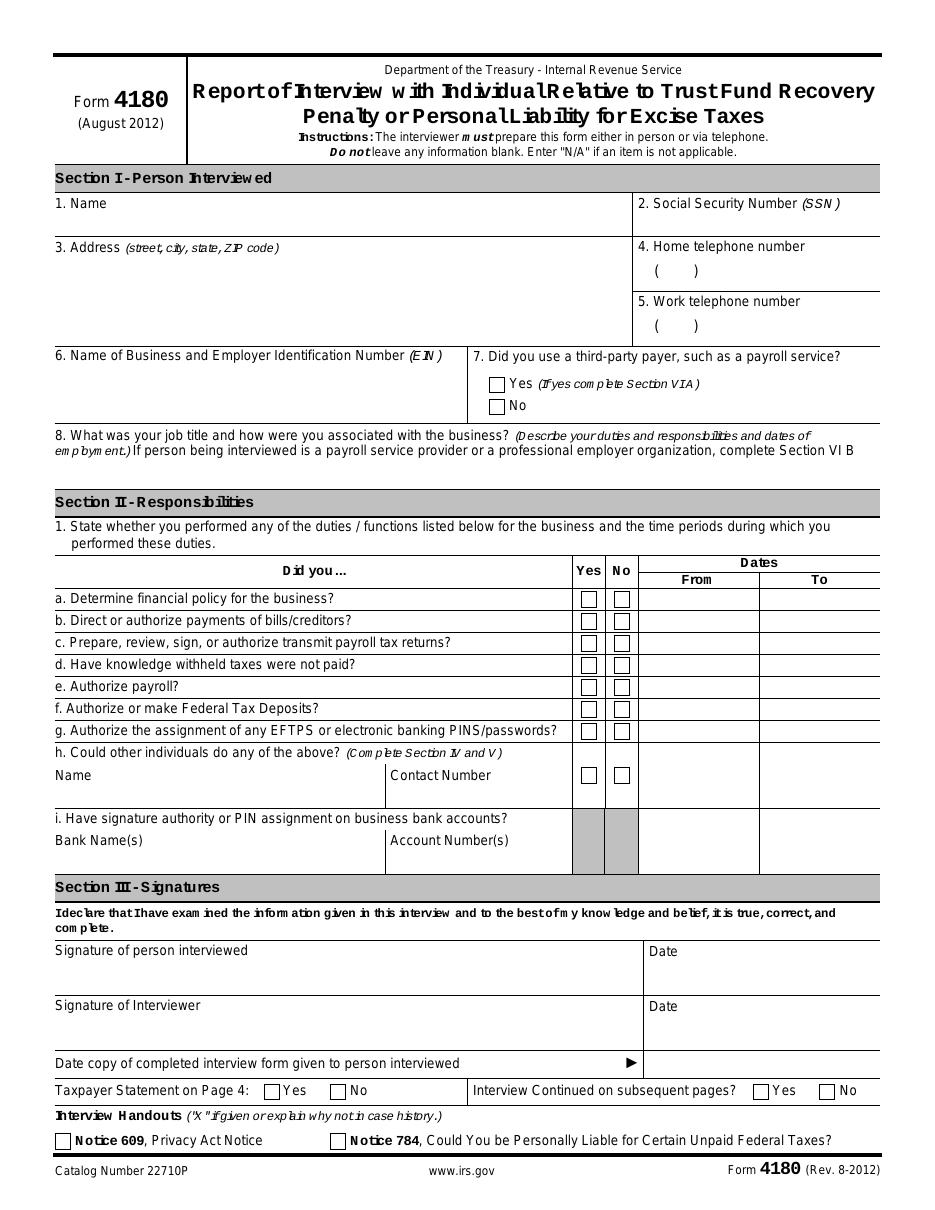 Official IRS PDF
 - Purpose
- The interview used to determine which individuals are responsible for unpaid payroll taxes.
- Who files
- Owners, officers, and other potentially responsible individuals identified by the IRS.
- When used
- When a business has unpaid trust-fund employment taxes and the IRS is identifying personally responsible parties.
Related services
What Form 4180 actually does
Form 4180, Report of Interview with Individual Relative to Trust Fund Recovery Penalty or Personal Liability for Excise Taxes, is the IRS's investigative interview used when a business has unpaid employment taxes (Form 941) and the IRS is deciding which individuals to personally assess under Section 6672 of the Internal Revenue Code. The Trust Fund Recovery Penalty (TFRP) equals 100% of the withheld income tax and the employee share of FICA that the business failed to remit — assessable against any person the IRS deems both responsible and willful.
The interview is intentionally detailed. It asks about your ownership stake, corporate title, signing authority on bank accounts, ability to hire and fire, involvement in selecting which creditors got paid when funds were tight, and specific knowledge that payroll deposits were not being made. Answers are used to build a responsibility case that supports assessment against you personally — the tax follows the individual even if the business closes or files bankruptcy.
Because Form 4180 answers are recorded, signed, and later relied on at Appeals and in Tax Court, taxpayers should almost always be represented by a CPA, attorney, or Enrolled Agent for the interview. Written responses through counsel are generally preferable to a live in-person interview, and the IRS's authority to compel the interview is limited.
How to file Form 4180, step by step
- 01
Do not attend an interview without representation
The 4180 interview is an investigative proceeding. Retain a credentialed representative and file Form 2848 before responding to the initial contact letter.
- 02
Request a written interview through counsel
The IRS Internal Revenue Manual permits written responses. This preserves accuracy, avoids gotcha follow-ups, and creates a clean record.
- 03
Assemble evidence of who actually controlled the funds
Bank signature cards, canceled checks, board minutes, employment agreements, and email or memo records showing who directed payroll deposits and who was excluded from those decisions.
- 04
Answer factually — do not minimize or embellish
The IRS cross-references your answers against bank records and interviews of co-workers. Misstatements support both TFRP assertion and, in serious cases, criminal referral.
- 05
Review and sign only after full agreement
You have the right to review, edit, and correct the interview record before signing. Never sign a version you have not read line by line with your representative.
Mistakes that get Form 4180 rejected
Related IRS forms
Form 4180 — frequently asked questions
Am I automatically responsible because I'm an officer?+
No. Corporate title alone is not enough. The IRS must show both responsibility (authority over the funds) and willfulness (knowing that trust-fund taxes were not being paid while paying other creditors).
Can more than one person be assessed the TFRP?+
Yes. The IRS regularly assesses the full penalty against every responsible-and-willful person. The IRS collects only once in total, but each assessed person's liability is joint and several until the balance is paid.
Can the TFRP be discharged in bankruptcy?+
No. The Trust Fund Recovery Penalty is a priority tax debt and is not dischargeable in Chapter 7 or Chapter 13.
Can I appeal a proposed TFRP?+
Yes. Letter 1153 gives you 60 days to file a written protest with the IRS Office of Appeals before the penalty is assessed. This is the best window to challenge responsibility and willfulness.
Need help with Form 4180?
A CPA can prepare and file Form 4180 correctly the first time — and represent you through whatever follows.
More IRS forms
Form 656
Offer in CompromiseForm 433-A
Collection Information Statement (Individuals)Form 433-B
Collection Information Statement (Businesses)Form 2848
Power of Attorney and Declaration of RepresentativeForm 8821
Tax Information AuthorizationForm 9465
Installment Agreement RequestForm 12153
Request for a Collection Due Process or Equivalent HearingForm 8857
Request for Innocent Spouse ReliefForm 843
Claim for Refund and Request for Abatement
The first call is free. The clarity it gives you is the whole point.
15 minutes with a credentialed CPA. We'll pull your IRS transcripts, walk through your real options, and tell you honestly whether you need representation — or whether you can handle it yourself.