
IRS Form 433-B
Collection Information Statement (Businesses)
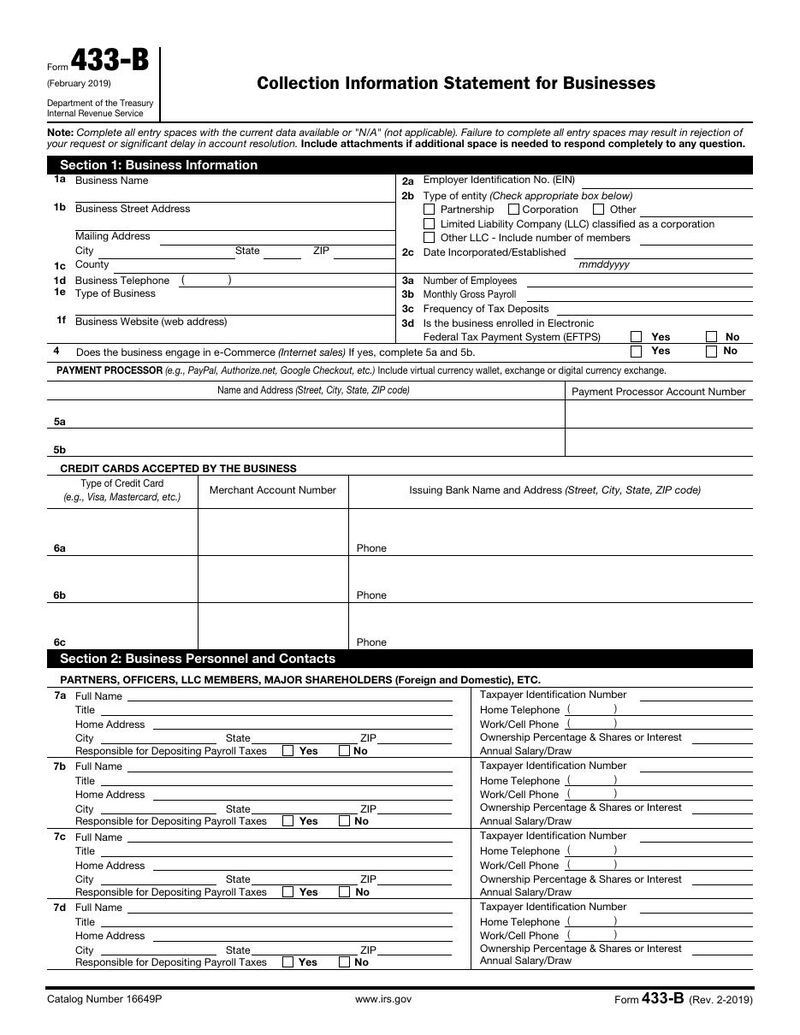
Form 433-B is the IRS Collection Information Statement businesses submit to disclose income, expenses, and assets when requesting an installment agreement or Offer in Compromise for business tax debt.
- Form
- Form 433-B
- Who files
- Corporations
- Last reviewed
- 2025
 Official IRS PDF
 - Purpose
- Business-side financial disclosure for installment agreements and OICs.
- Who files
- Corporations, partnerships, and LLCs requesting resolution of business tax debt.
- When used
- Submitted with business resolution requests over IRS streamlined thresholds.
What Form 433-B actually does
Form 433-B, Collection Information Statement for Businesses, is the IRS's primary financial disclosure for corporations, partnerships, LLCs, and other business entities that owe federal tax and need a resolution above the streamlined thresholds. It is separate from Form 433-A, which covers individuals — a small-business owner with both personal liabilities and a business balance typically files both.
The form documents business bank and merchant accounts, accounts receivable, inventory, equipment, real property, vehicles, and other business assets, along with a full profit-and-loss picture from the most recent complete tax year and the year to date. The IRS uses this data to calculate the business's Reasonable Collection Potential and to decide whether the business is a going concern that can support a payment plan or a failing operation better resolved through an Offer in Compromise, Currently Not Collectible status, or a shutdown.
For payroll tax cases the IRS often runs Form 433-B in parallel with Form 4180 trust-fund interviews so it can pursue both the business balance and personally responsible individuals under the Trust Fund Recovery Penalty at the same time.
How to file Form 433-B, step by step
- 01
Assemble 6-12 months of business records
Pull the last complete year's tax return, current-year P&L and balance sheet, 3-6 months of business bank and merchant statements, accounts receivable aging, current loan and lease agreements, and asset lists with recent appraisals or depreciation schedules.
- 02
Complete Sections 1-3 (business ID and structure)
Legal name, EIN, entity type, filing history, and every ownership interest of 20% or more. The IRS cross-checks ownership against state records and prior returns.
- 03
Complete Section 4 (business assets)
Every operating and depository account, accounts receivable, inventory, equipment, vehicles, and real estate. Report Quick Sale Value (generally 80% of fair market value) net of secured debt.
- 04
Complete Section 5 (business income and expenses)
Gross receipts, cost of goods sold, and each ordinary and necessary operating expense. The IRS reconciles these against filed returns — inconsistencies trigger deeper review.
- 05
Sign as an authorized officer and attach substantiation
The form must be signed by a corporate officer, partner, or LLC member with authority. Attach copies of the supporting statements and file returns you referenced.
Mistakes that get Form 433-B rejected
Related IRS forms
Form 433-B — frequently asked questions
Do I file 433-B if I'm a single-member LLC?+
Usually no. A single-member LLC treated as a disregarded entity files 433-A because the tax debt is the owner's personal liability. Multi-member LLCs and LLCs that elected corporate taxation file 433-B.
How current do the financials need to be?+
Within 6 months. If the case drags on longer than that the assigned Revenue Officer will request an updated 433-B before any resolution is finalized.
Will the IRS require a business shutdown?+
Only when the business cannot meet current federal deposit obligations and continues to accrue new liability. A viable business that is current on new deposits is almost always allowed to continue while resolving back debt.
Can I substitute my accountant's financial statements?+
The IRS requires the 433-B format itself. Compiled or reviewed statements are useful supporting documents but do not replace the form.
Need help with Form 433-B?
A CPA can prepare and file Form 433-B correctly the first time — and represent you through whatever follows.
More IRS forms
Form 656
Offer in CompromiseForm 433-A
Collection Information Statement (Individuals)Form 2848
Power of Attorney and Declaration of RepresentativeForm 8821
Tax Information AuthorizationForm 9465
Installment Agreement RequestForm 12153
Request for a Collection Due Process or Equivalent HearingForm 8857
Request for Innocent Spouse ReliefForm 843
Claim for Refund and Request for AbatementForm 4180
Report of Interview with Individual Relative to TFRP
The first call is free. The clarity it gives you is the whole point.
15 minutes with a credentialed CPA. We'll pull your IRS transcripts, walk through your real options, and tell you honestly whether you need representation — or whether you can handle it yourself.