

IRS Form 843
Claim for Refund and Request for Abatement
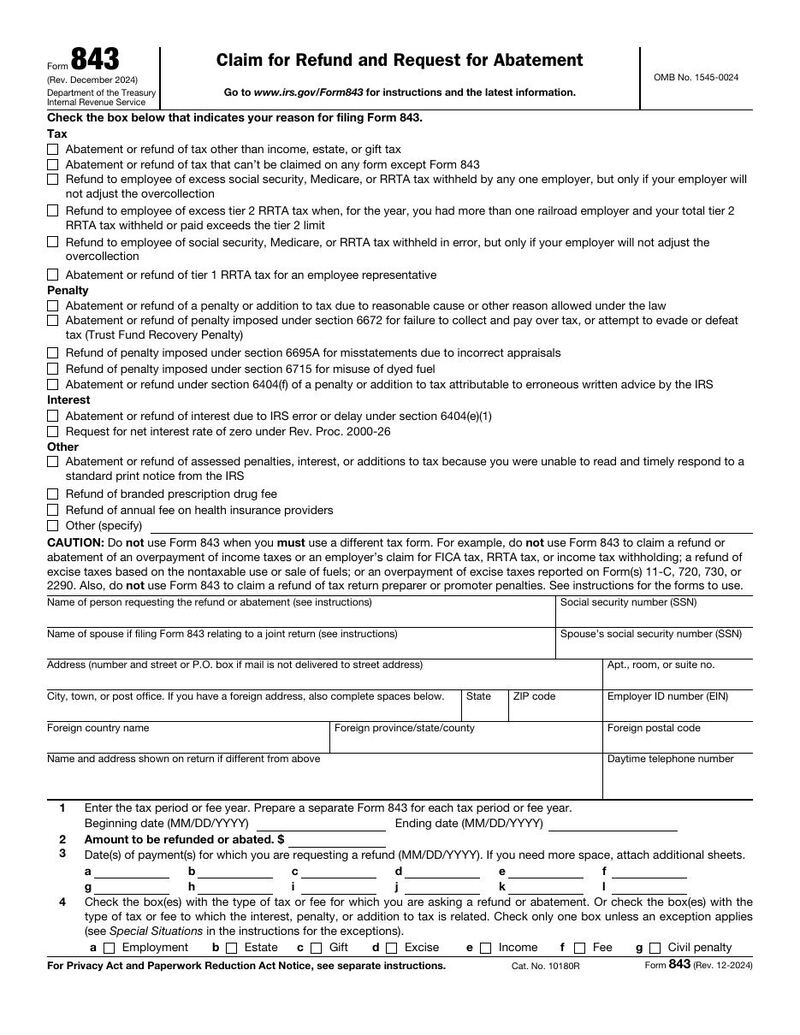
Form 843 is the IRS claim used to request abatement of certain penalties and interest or a refund of certain non-income taxes.
- Form
- Form 843
- Who files
- Taxpayers requesting penalty abatement or interest refunds
- Last reviewed
- 2025
 Official IRS PDF
 - Purpose
- Requests abatement of certain penalties, interest, or refund of certain taxes.
- Who files
- Taxpayers requesting penalty abatement or interest refunds.
- When used
- After penalties or interest have been assessed.
Related services
What Form 843 actually does
Form 843, Claim for Refund and Request for Abatement, is a general-purpose IRS form used to ask the IRS to remove penalties, refund penalties or interest already paid, or refund certain excise, employment, and estate taxes assessed in error. It is not used for income-tax refunds — those go through amended returns like 1040-X or 1120-X.
In tax resolution practice, Form 843 is most often filed to request penalty abatement — either first-time abatement (available once every 3 years to taxpayers with a clean compliance history) or reasonable-cause abatement (available when circumstances outside your control caused the noncompliance, such as serious illness, natural disaster, unavoidable absence, reliance on incorrect written advice, or fire and casualty). Interest abatement is much narrower and generally requires IRS error or delay under Section 6404(e).
First-time abatement can now be requested by phone in many cases, but Form 843 is still the safest paper record — especially when combining first-time abatement with reasonable-cause arguments or requesting abatement across multiple periods.
How to file Form 843, step by step
- 01
Verify the underlying return is filed and the tax is paid or on a plan
The IRS will not abate penalties on unfiled or delinquent balances that are not on an installment agreement. Get compliant first, then request abatement.
- 02
Choose the correct basis on Line 5a and 5b
First-time abatement, reasonable cause, IRS error, or statutory exception. Selecting the wrong basis is the most common reason for rejection.
- 03
Write the explanation on Line 7
Explain the facts and dates in plain language and tie them to the abatement basis. Attach supporting documents — hospital records, death certificates, insurance claims, or the incorrect IRS notice you relied on.
- 04
Compute the amount requested
State the penalty amount to be abated and, if paid, the refund amount. Requesting a specific dollar figure supported by an IRS notice is far more effective than a vague 'all penalties.'
- 05
Sign and mail to the IRS service center that handled the original return
Not the local office. The correct service center is listed in the Form 843 instructions and depends on the return type and your state.
Mistakes that get Form 843 rejected
Related IRS forms
Form 843 — frequently asked questions
Can I request first-time abatement over the phone?+
Yes, in many cases. Call the number on your IRS notice and ask specifically for First-Time Abate. File Form 843 only if the phone request is denied or you also want reasonable-cause abatement.
Does the IRS abate interest?+
Rarely. Interest can be abated only when it is attributable to unreasonable IRS error or delay under Section 6404(e). Interest on an original tax liability generally continues to accrue and cannot be abated.
What is 'reasonable cause'?+
The IRS defines it as circumstances that prevented compliance despite the exercise of ordinary business care and prudence. Common accepted causes include serious illness, death in the immediate family, casualty or natural disaster, and reliance on incorrect written IRS advice.
How long does it take to hear back?+
Typically 60-120 days. If the IRS denies the request you can appeal to the IRS Office of Appeals within 30 days of the denial letter.
Need help with Form 843?
A CPA can prepare and file Form 843 correctly the first time — and represent you through whatever follows.
More IRS forms
Form 656
Offer in CompromiseForm 433-A
Collection Information Statement (Individuals)Form 433-B
Collection Information Statement (Businesses)Form 2848
Power of Attorney and Declaration of RepresentativeForm 8821
Tax Information AuthorizationForm 9465
Installment Agreement RequestForm 12153
Request for a Collection Due Process or Equivalent HearingForm 8857
Request for Innocent Spouse ReliefForm 4180
Report of Interview with Individual Relative to TFRP
The first call is free. The clarity it gives you is the whole point.
15 minutes with a credentialed CPA. We'll pull your IRS transcripts, walk through your real options, and tell you honestly whether you need representation — or whether you can handle it yourself.