

IRS Form 9465
Installment Agreement Request
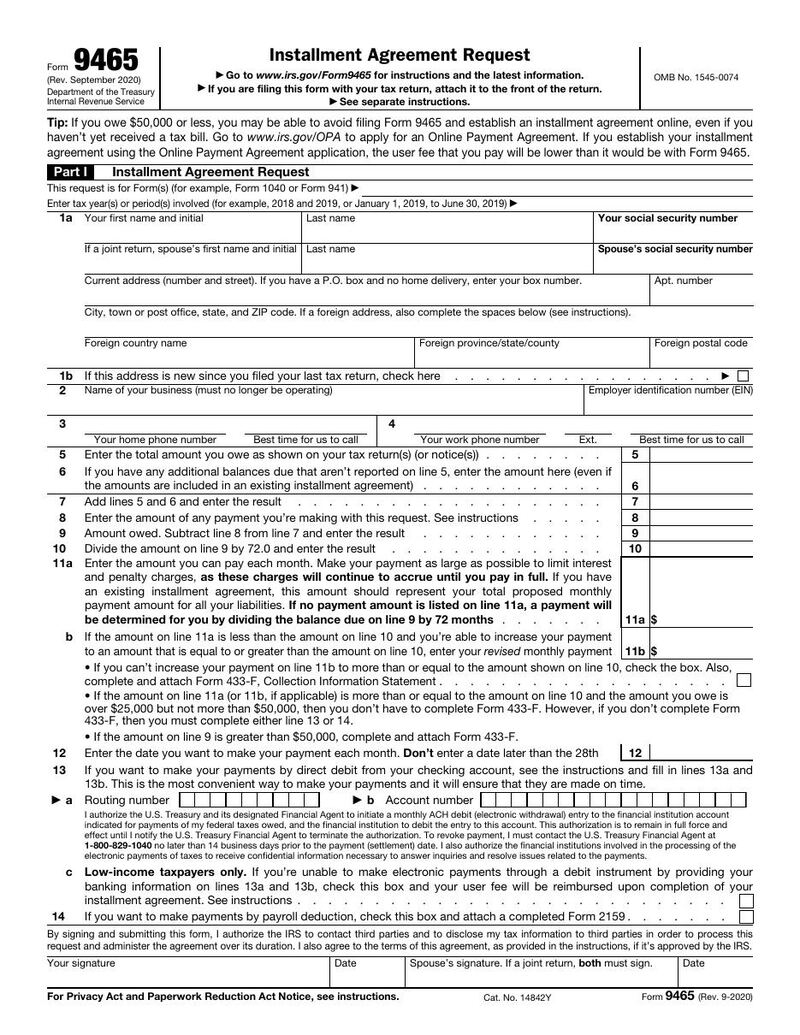
Form 9465 is the IRS Installment Agreement Request — used to set up monthly payments on unpaid federal taxes when you cannot pay the balance in full.
- Form
- Form 9465
- Who files
- Individuals or businesses unable to pay their balance in full
- Last reviewed
- 2025
 Official IRS PDF
 - Purpose
- Requests a monthly payment plan for unpaid federal taxes.
- Who files
- Individuals or businesses unable to pay their balance in full.
- When used
- Filed with a balance-due return or in response to IRS collection notices.
Related services
What Form 9465 actually does
Form 9465, Installment Agreement Request, is the IRS form individuals and businesses use to request a monthly payment plan on a federal tax balance. Most individuals with balances of $50,000 or less can also set up a payment plan online without filing Form 9465 at all — but the paper form is required for higher balances and certain business situations.
Installment agreements come in several flavors: guaranteed (under $10,000 paid in 3 years), streamlined ($50,000 or less paid in 72 months, minimal documentation), in-business trust fund express (for businesses under $25,000), and non-streamlined / partial-pay (over the streamlined threshold or where Form 433-A or 433-B financial disclosure is required).
Interest and the failure-to-pay penalty continue to accrue while you're on an installment agreement, though the failure-to-pay penalty drops from 0.5% to 0.25% per month once the agreement is in effect. The IRS may still file a Notice of Federal Tax Lien depending on the balance and agreement type — direct debit installment agreements generally avoid lien filing for streamlined balances.
How to file Form 9465, step by step
- 01
Decide whether you actually need Form 9465
If you owe $50,000 or less (individuals) or $25,000 or less (businesses) and can pay within 72 months, use the IRS Online Payment Agreement tool instead — it's faster and cheaper than filing Form 9465.
- 02
Calculate a payment you can actually sustain
Total balance ÷ months remaining on the collection statute (or 72, whichever is shorter). The IRS will accept lower payments only after a Form 433-A or 433-B financial disclosure proves you can't pay more.
- 03
Complete Form 9465 lines 1-13
Identifying information, the tax return and tax years involved, the total amount owed, and your proposed monthly payment amount and payment date (1st-28th of each month).
- 04
Choose your payment method (lines 13a-13c)
Direct debit is strongly preferred — it lowers the user fee and avoids default for non-payment. Provide your routing and account numbers.
- 05
Attach Form 433-F or 433-A if required
Required for balances over the streamlined thresholds. Form 433-F is the shorter version the IRS often accepts in lieu of the full Form 433-A for installment agreement purposes.
- 06
File Form 9465
Attach to your tax return (preferred when filing with a balance due) or mail to the address in the instructions. Allow 30 days for a written response.
Mistakes that get Form 9465 rejected
Form 9465 — frequently asked questions
What's the user fee for an installment agreement?+
As of 2024: $31 for online direct-debit setup, $107 for online non-direct-debit, $225 for paper setup, $43 for low-income taxpayers (reimbursed for low-income direct-debit).
Will the IRS file a tax lien?+
Generally no for streamlined direct-debit installment agreements on balances of $50,000 or less. The IRS may file a Notice of Federal Tax Lien on larger balances or non-direct-debit agreements.
What if I can't afford the streamlined payment?+
File Form 9465 along with Form 433-A or 433-F to request a partial-pay installment agreement (PPIA). Payments are based on your actual ability to pay; any balance unpaid when the collection statute expires is written off.
Can I change my payment amount later?+
Yes, by calling the IRS or filing Form 9465 again. The IRS will review your current financial situation before approving a change.
Need help with Form 9465?
A CPA can prepare and file Form 9465 correctly the first time — and represent you through whatever follows.
More IRS forms
Form 656
Offer in CompromiseForm 433-A
Collection Information Statement (Individuals)Form 433-B
Collection Information Statement (Businesses)Form 2848
Power of Attorney and Declaration of RepresentativeForm 8821
Tax Information AuthorizationForm 12153
Request for a Collection Due Process or Equivalent HearingForm 8857
Request for Innocent Spouse ReliefForm 843
Claim for Refund and Request for AbatementForm 4180
Report of Interview with Individual Relative to TFRP
The first call is free. The clarity it gives you is the whole point.
15 minutes with a credentialed CPA. We'll pull your IRS transcripts, walk through your real options, and tell you honestly whether you need representation — or whether you can handle it yourself.