
IRS Form 12153
Request for a Collection Due Process or Equivalent Hearing
Form 12153 is the request for a Collection Due Process (CDP) hearing — your one chance to challenge an IRS levy or lien before an independent Appeals Officer and, if needed, in U.S. Tax Court.
- Form
- Form 12153
- Who files
- Anyone who received Letter 1058
- Last reviewed
- 2025
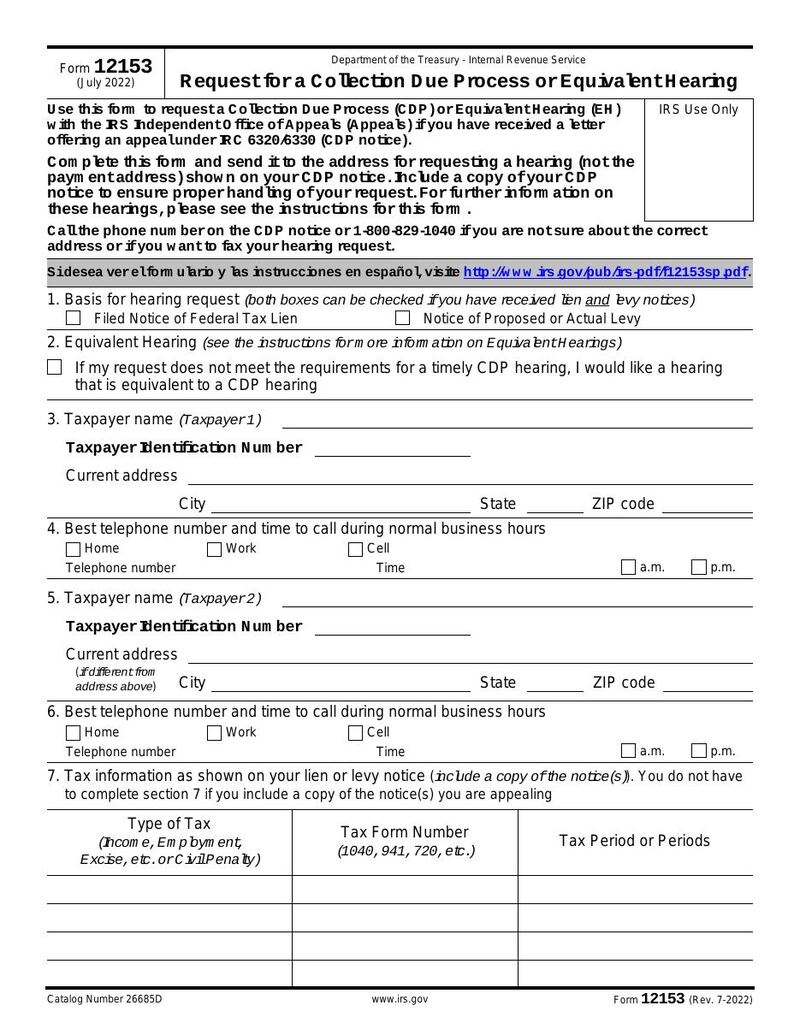 Official IRS PDF
 - Purpose
- Requests a CDP hearing in response to a Final Notice of Intent to Levy or Notice of Federal Tax Lien Filing.
- Who files
- Anyone who received Letter 1058, LT11, or Letter 3172.
- When used
- Must be filed within 30 days of the notice. Missing the deadline forfeits CDP rights (equivalent hearing only).
Related services
What Form 12153 actually does
Form 12153, Request for a Collection Due Process or Equivalent Hearing, gives you the right to an independent review by IRS Appeals before the IRS can levy your wages or bank accounts (or after a Notice of Federal Tax Lien is filed). It is the single most important deadline in IRS collection enforcement — miss it and you lose the right to Tax Court review.
You have exactly 30 days from the date on the qualifying notice — typically Letter 1058, LT11 (Final Notice of Intent to Levy and Notice of Your Right to a Hearing), or Letter 3172 (Notice of Federal Tax Lien Filing and Right to a Hearing) — to file Form 12153. The form must be postmarked by the 30th day; the IRS strictly enforces the deadline.
At the CDP hearing you can raise the appropriateness of the collection action and propose collection alternatives (installment agreement, OIC, currently not collectible status), challenge the existence or amount of the underlying liability (only if you didn't have a prior opportunity to do so), and raise spousal defenses. The hearing officer issues a Notice of Determination; you have 30 days from that determination to petition the U.S. Tax Court.
Filing Form 12153 also suspends IRS levy action while the hearing is pending — a critical protection if your wages or bank accounts are at risk.
How to file Form 12153, step by step
- 01
Identify which notice you received
Form 12153 is filed in response to Letter 1058 / LT11 (levy) or Letter 3172 (lien). The 30-day clock starts the day after the notice date — not the day you received it.
- 02
Decide CDP vs. Equivalent Hearing
Within 30 days = full Collection Due Process hearing with Tax Court review rights. Day 31 to 1 year = Equivalent Hearing only (no Tax Court appeal). Always file within 30 days when possible.
- 03
Complete Form 12153
Identify yourself, the tax periods involved, and check the box(es) showing which notice you received. Most importantly, on line 11, clearly state the issues you want to raise (collection alternative, innocent spouse, statute of limitations, etc.).
- 04
Articulate every issue you want considered
Issues not raised on Form 12153 are generally waived. Common entries: 'request installment agreement,' 'request Offer in Compromise consideration,' 'request currently not collectible status,' 'dispute liability — no prior opportunity to dispute,' 'innocent spouse relief.'
- 05
File before the deadline
Mail to the address shown on your notice. Use Certified Mail with Return Receipt — IRS computation of timeliness is by postmark date. Faxed CDP requests are accepted if the notice provides a fax number.
- 06
Prepare for the hearing
Appeals will schedule a phone or in-person conference 4-9 months later. Be ready with a current financial statement (Form 433-A or 433-B), all required tax returns filed, and your proposed resolution.
Mistakes that get Form 12153 rejected
Related IRS forms
Form 12153 — frequently asked questions
What if I missed the 30-day deadline?+
You can still file Form 12153 within 1 year and request an Equivalent Hearing. You get the same Appeals review and can negotiate the same collection alternatives — but you lose the right to Tax Court review of the determination.
Does filing Form 12153 stop a levy?+
Yes. Timely-filed CDP requests suspend most levy action until the hearing is concluded and the Notice of Determination is issued (and during any Tax Court appeal). It does not unfile existing tax liens.
Can I represent myself at the CDP hearing?+
Yes, but most taxpayers benefit from CPA, attorney, or EA representation because the hearing is the last administrative opportunity to resolve the case before Tax Court.
Can I challenge the underlying tax at a CDP hearing?+
Only if you did not have a prior opportunity to dispute it — for example, if you didn't receive a Statutory Notice of Deficiency or didn't otherwise have an Appeals opportunity. If you had a prior chance, the hearing is limited to collection alternatives.
Need help with Form 12153?
A CPA can prepare and file Form 12153 correctly the first time — and represent you through whatever follows.
More IRS forms
Form 656
Offer in CompromiseForm 433-A
Collection Information Statement (Individuals)Form 433-B
Collection Information Statement (Businesses)Form 2848
Power of Attorney and Declaration of RepresentativeForm 8821
Tax Information AuthorizationForm 9465
Installment Agreement RequestForm 8857
Request for Innocent Spouse ReliefForm 843
Claim for Refund and Request for AbatementForm 4180
Report of Interview with Individual Relative to TFRP
The first call is free. The clarity it gives you is the whole point.
15 minutes with a credentialed CPA. We'll pull your IRS transcripts, walk through your real options, and tell you honestly whether you need representation — or whether you can handle it yourself.