
IRS Form 433-A
Collection Information Statement (Individuals)
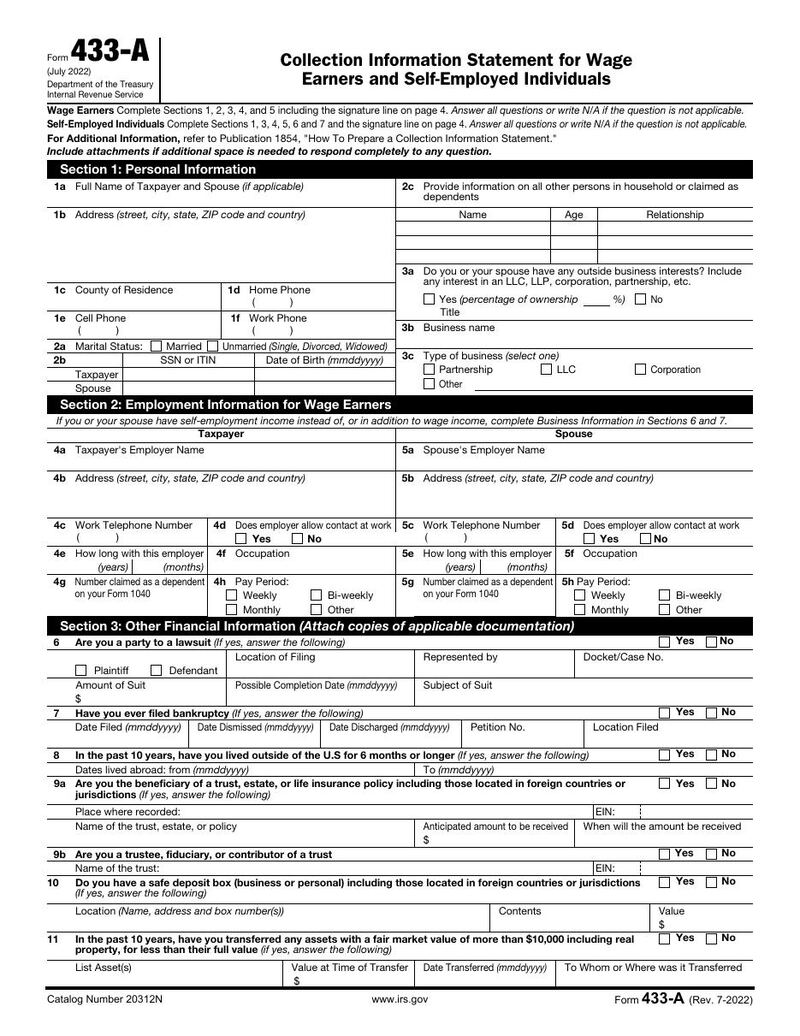
Form 433-A is the IRS Collection Information Statement that wage earners and self-employed individuals use to disclose income, expenses, and assets when requesting an installment agreement, CNC status, or Offer in Compromise.
- Form
- Form 433-A
- Who files
- Wage earners and self-employed individuals requesting installment agreements
- Last reviewed
- 2025
 Official IRS PDF
 - Purpose
- Detailed financial disclosure used by the IRS to evaluate ability to pay.
- Who files
- Wage earners and self-employed individuals requesting installment agreements, currently not collectible status, or OICs.
- When used
- Required for most non-streamlined installment agreements and CNC status requests.
What Form 433-A actually does
Form 433-A, Collection Information Statement for Wage Earners and Self-Employed Individuals, is the primary financial disclosure the IRS uses to evaluate ability to pay. It is required for most non-streamlined installment agreements (over $50,000), Currently Not Collectible (CNC) status requests, and as part of an Offer in Compromise (which uses the slightly different Form 433-A OIC).
The form asks for a complete picture of your financial life: employment income, business income, real estate, vehicles, bank accounts, investments, retirement accounts, monthly living expenses, and other assets and liabilities. The IRS then applies its own Collection Financial Standards — national and local allowable amounts for housing, food, transportation, and out-of-pocket healthcare — to determine your monthly disposable income.
Honesty and completeness matter. The IRS verifies income against W-2s, 1099s, and bank deposits and verifies assets through public records and credit reports. Material misstatements can support fraud penalties and, in serious cases, criminal referral.
How to file Form 433-A, step by step
- 01
Pull 3 months of supporting documents
Gather 3 months of pay stubs, 3 months of bank statements for every account, current mortgage and vehicle loan statements, the most recent property tax bill, health insurance and out-of-pocket medical expense records, and proof of any court-ordered payments.
- 02
Complete Sections 1-4 (personal & employment)
Identifying information, household members, employment, and self-employment business information. Be precise about pay frequency — the IRS converts everything to monthly amounts.
- 03
Complete Section 5 (other financial information)
Disclose lawsuits, anticipated inheritances, transfers of assets in the past 10 years, and trusts. Omissions here are heavily scrutinized.
- 04
Complete Sections 6-7 (assets)
List every bank account, investment, retirement account, real estate property, vehicle, and other asset. The IRS calculates Quick Sale Value (typically 80% of fair market value) less any encumbrances.
- 05
Complete Section 8 (income and expenses)
Report gross monthly income from every source. List actual monthly expenses; the IRS will substitute its Collection Financial Standard when your claimed expense exceeds the allowable amount.
- 06
Sign, date, and submit with supporting documents
Submit to the assigned Revenue Officer or to the address provided in your collection notice. Keep a complete signed copy and proof of mailing.
Mistakes that get Form 433-A rejected
Related IRS forms
Form 433-A — frequently asked questions
Is Form 433-A the same as Form 433-A (OIC)?+
No. Form 433-A is for installment agreements and CNC status. Form 433-A (OIC) is a longer version used only with an Offer in Compromise on Form 656. They are not interchangeable.
What are the IRS Collection Financial Standards?+
Allowable monthly expense amounts the IRS uses in place of actual expenses when actual is higher. They cover food/clothing, housing/utilities (by county), transportation (by region), and out-of-pocket healthcare. Updated annually.
Do I have to submit Form 433-A for every installment agreement?+
No. Streamlined installment agreements ($50,000 or less paid within 72 months for individuals) don't require Form 433-A. It's required for amounts above the streamlined thresholds and for partial-pay installment agreements.
Can I keep my retirement accounts?+
Generally yes — the IRS counts retirement accounts as assets but rarely forces liquidation. They are typically valued at the cash-out amount net of taxes and penalties for RCP purposes.
Need help with Form 433-A?
A CPA can prepare and file Form 433-A correctly the first time — and represent you through whatever follows.
More IRS forms
Form 656
Offer in CompromiseForm 433-B
Collection Information Statement (Businesses)Form 2848
Power of Attorney and Declaration of RepresentativeForm 8821
Tax Information AuthorizationForm 9465
Installment Agreement RequestForm 12153
Request for a Collection Due Process or Equivalent HearingForm 8857
Request for Innocent Spouse ReliefForm 843
Claim for Refund and Request for AbatementForm 4180
Report of Interview with Individual Relative to TFRP
The first call is free. The clarity it gives you is the whole point.
15 minutes with a credentialed CPA. We'll pull your IRS transcripts, walk through your real options, and tell you honestly whether you need representation — or whether you can handle it yourself.