

IRS Form 8857
Request for Innocent Spouse Relief
Form 8857 requests relief from joint tax liability under one of three IRS innocent-spouse programs when the tax was actually attributable to your current or former spouse.
- Form
- Form 8857
- Who files
- Current or former spouses who filed jointly and didn't know about the understated tax
- Last reviewed
- 2025
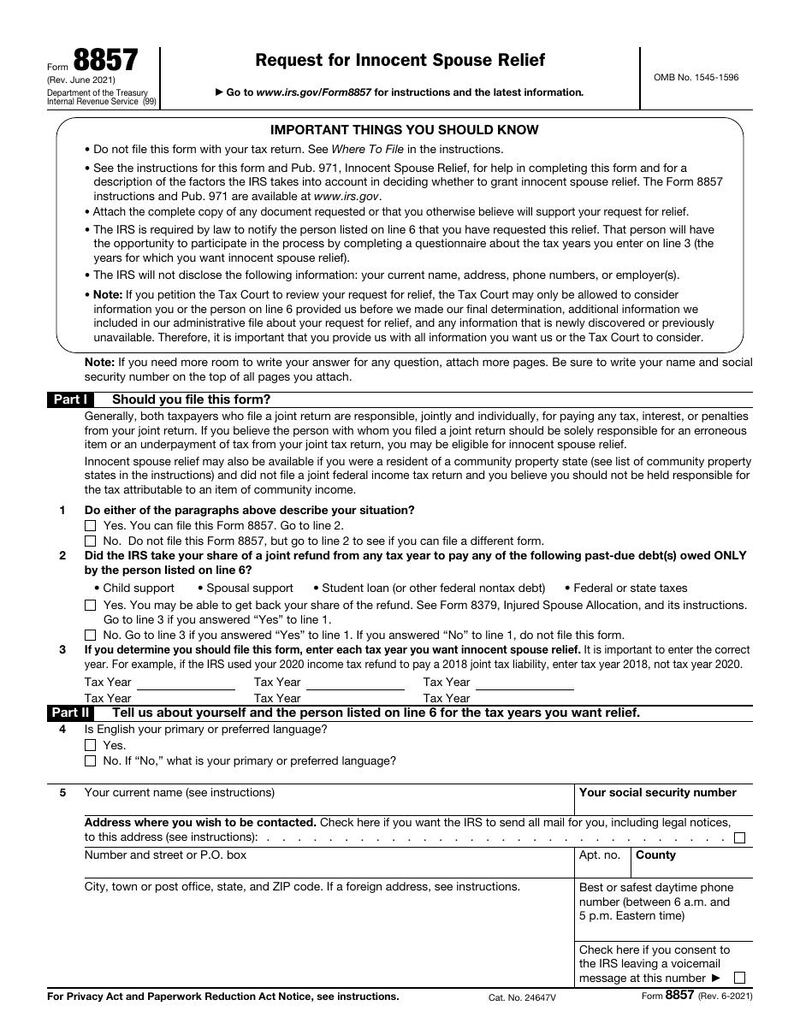 Official IRS PDF
 - Purpose
- Requests relief from joint tax liability under one of three IRS relief categories.
- Who files
- Current or former spouses who filed jointly and didn't know about the understated tax.
- When used
- Generally within 2 years of the IRS's first collection action.
Related services
What Form 8857 actually does
Form 8857, Request for Innocent Spouse Relief, is filed by a current or former spouse who signed a joint return and wants the IRS to remove or reduce their share of the resulting tax, interest, and penalties. The joint-and-several liability rule normally makes both spouses fully responsible for the entire balance; Section 6015 of the Internal Revenue Code provides three narrow paths out of that rule.
Traditional innocent spouse relief (Section 6015(b)) requires a showing that the tax understatement came from the other spouse's erroneous items and that you did not know and had no reason to know about it. Separation of liability relief (Section 6015(c)) is available to divorced, legally separated, or living-apart spouses and allocates the deficiency between the two. Equitable relief (Section 6015(f)) is a catch-all for situations that don't fit the first two, including underpayment (as opposed to understatement) cases and abusive-relationship situations.
Once Form 8857 is filed, the IRS is required to notify the non-requesting spouse and give them an opportunity to participate. Collection against the requesting spouse is generally suspended while the request is under consideration, and the requesting spouse has the right to appeal an adverse determination to Tax Court.
How to file Form 8857, step by step
- 01
Confirm the tax years qualify
Traditional and separation-of-liability relief must generally be requested within 2 years after the IRS's first collection activity against you. Equitable relief has a longer window tied to the collection statute (usually 10 years from assessment).
- 02
Gather documentation of the erroneous items
Copies of the joint returns, W-2s and 1099s that show whose income and deductions created the deficiency, divorce decrees, protective orders, financial records showing separate finances, and any evidence of abuse or financial control.
- 03
Complete Parts I-V truthfully
The form asks about your marital and living situation, your involvement in preparing the returns, your education and business experience, and your knowledge of the items in question. The IRS weighs these factors under the Rev. Proc. 2013-34 threshold and equitable-factors tests.
- 04
Attach a written statement of facts
The pre-printed spaces on the form are almost never enough. Attach a chronological narrative explaining how the tax arose, what you knew and when, and why relief is appropriate. This narrative is often the deciding document.
- 05
Submit to the correct IRS address
Mail to the IRS Innocent Spouse Operation in Covington, KY at the address in the current Form 8857 instructions. Keep proof of mailing.
Mistakes that get Form 8857 rejected
Related IRS forms
Form 8857 — frequently asked questions
Does the IRS have to tell my ex-spouse I filed?+
Yes. The IRS is required by statute to notify the non-requesting spouse and let them participate in the process. The IRS does not, however, disclose your new address or contact information.
Can I get relief for underpayment cases?+
Only under equitable relief (Section 6015(f)). Traditional and separation-of-liability relief require an understatement of tax, not an unpaid balance from a correctly reported return.
What if my request is denied?+
You have 90 days from the Notice of Determination to petition the U.S. Tax Court. Tax Court review of innocent-spouse denials is de novo, meaning the court decides the facts fresh rather than deferring to the IRS.
Does filing Form 8857 stop IRS collection?+
In most cases yes. The IRS generally suspends collection against the requesting spouse from the date the request is filed through 60 days after a final determination or Tax Court decision.
Need help with Form 8857?
A CPA can prepare and file Form 8857 correctly the first time — and represent you through whatever follows.
More IRS forms
Form 656
Offer in CompromiseForm 433-A
Collection Information Statement (Individuals)Form 433-B
Collection Information Statement (Businesses)Form 2848
Power of Attorney and Declaration of RepresentativeForm 8821
Tax Information AuthorizationForm 9465
Installment Agreement RequestForm 12153
Request for a Collection Due Process or Equivalent HearingForm 843
Claim for Refund and Request for AbatementForm 4180
Report of Interview with Individual Relative to TFRP
The first call is free. The clarity it gives you is the whole point.
15 minutes with a credentialed CPA. We'll pull your IRS transcripts, walk through your real options, and tell you honestly whether you need representation — or whether you can handle it yourself.