

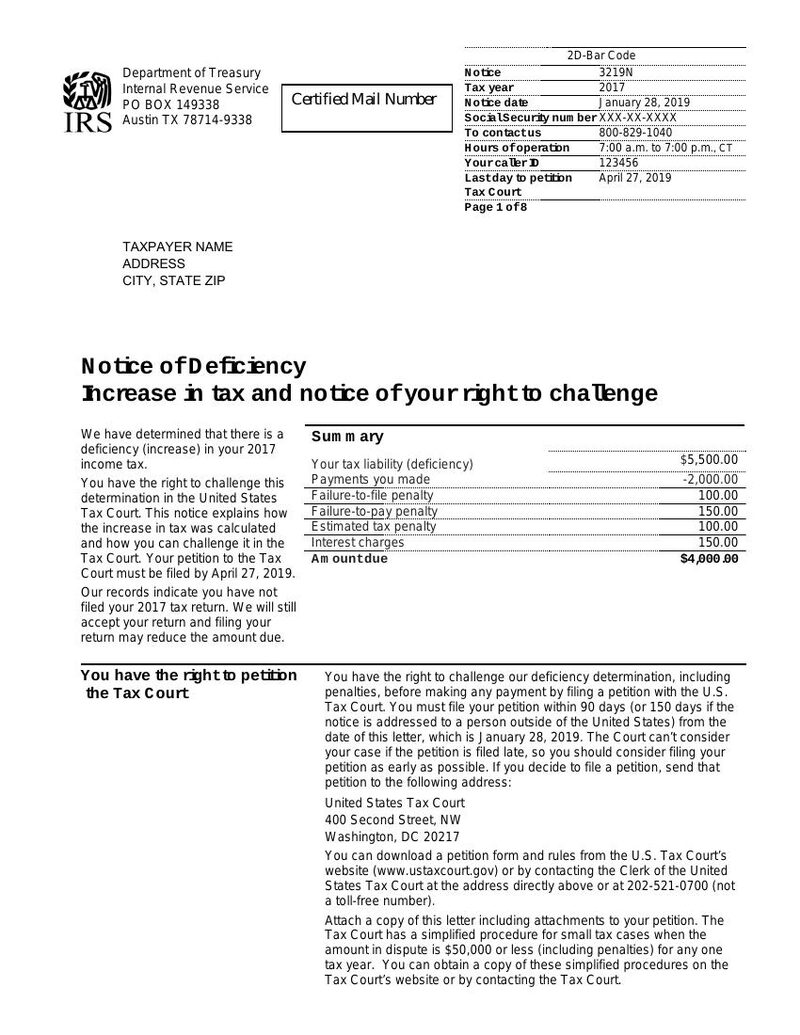
Why you got an IRS Notice of Deficiency
- You didn't respond to a CP2000 underreporter notice.
- An audit (Letter 525) concluded without agreement and went through Appeals.
- The IRS is asserting a deficiency from a substitute-for-return assessment.
What happens if you ignore this notice
If you don't petition Tax Court within 90 days, you must pay first and sue for a refund later. You lose valuable rights.
How to respond to a Notice of Deficiency
Recommended completion window: within 90 days of the notice date
- 1
Calendar the 90-day deadline today
Use the notice date, not the date you opened the mail. The 90th calendar day is your filing deadline.
- 2
Decide: pay, petition, or both
Petitioning Tax Court preserves your no-pay rights. Paying the tax and suing for a refund in district court is the alternative.
- 3
Prepare the Tax Court petition
Use the Tax Court's online filing system or mail Form 2 (Petition). Small Tax Case procedure (under $50,000 per year) is simpler but has no appeal.
- 4
Expect IRS Appeals to contact you
Most petitioned cases are referred back to Appeals for settlement before trial.
- 5
Hire a CPA, EA, or tax attorney admitted to Tax Court
Tax Court representation is restricted to admitted practitioners. A CPA partnered with Tax Court counsel can manage the underlying tax dispute.
Common mistakes with a Notice of Deficiency
- Treating the notice as just another bill and paying without preserving Tax Court rights.
- Filing the petition late — even one day past 90 forfeits the no-pay path.
- Choosing Small Tax Case procedure without realizing it waives the right to appeal.
IRS forms referenced
Form 2848
Power of Attorney and Declaration of Representative
View form details
Frequently asked questions about Notice of Deficiency
What is the 90-day letter from the IRS?
+
It's the Statutory Notice of Deficiency (usually CP3219A or CP3219N). It gives you 90 days (150 if abroad) to petition the U.S. Tax Court to dispute the proposed tax before it's assessed.
Can the IRS extend the 90-day deadline?
+
No. The 90-day period is set by statute (IRC §6213). Neither the IRS nor the Tax Court can extend it. A petition mailed by the deadline counts as filed on time under the timely-mailing rule.
What happens if I miss the 90 days?
+
The IRS assesses the proposed tax. Your remaining options are paying the balance and suing for a refund in U.S. District Court or the Court of Federal Claims, or addressing the assessed balance through collection alternatives like an installment agreement or Offer in Compromise.
Reviewed by Franklin Sofi, MBA, CPA, CTRS — Founder & Tax Resolution Specialist at Comprehensive Tax Resolution. Last reviewed November 2025.
This page is general information, not legal or tax advice. For specific guidance on your IRS notice, contact a qualified CPA or tax resolution specialist.