
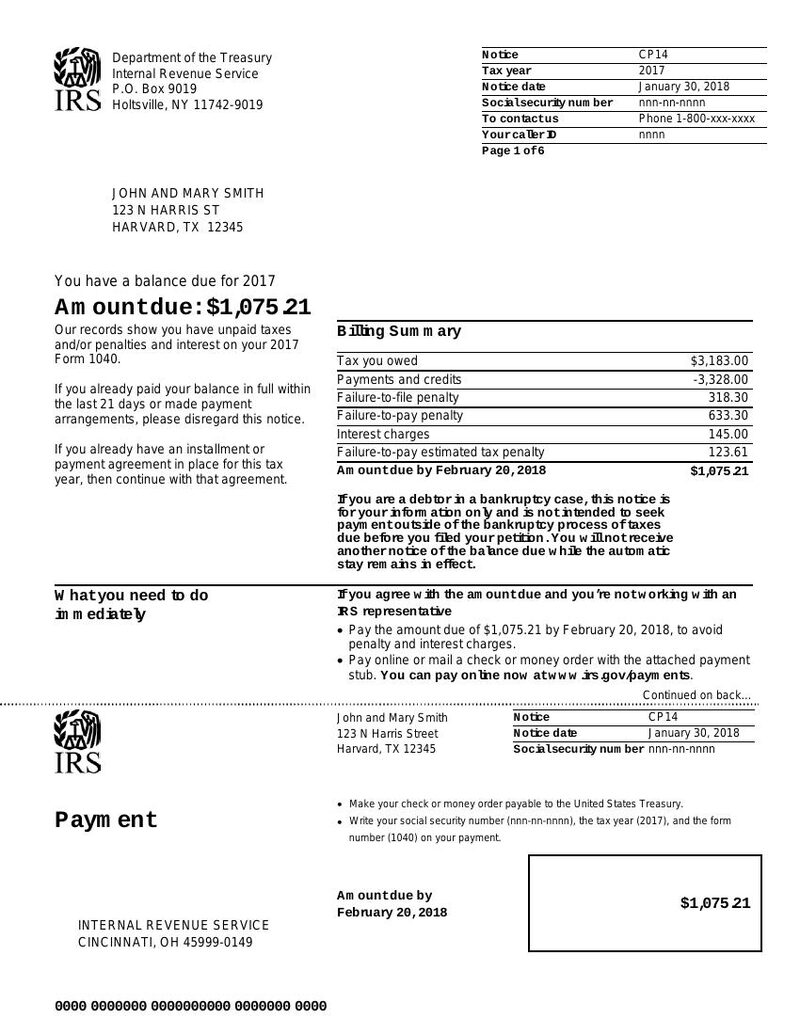
Why you got an IRS CP14
- You filed a return but didn't pay the full balance due.
- An IRS adjustment (math error, missing payment, or amended return) created a new balance.
- Estimated-tax payments fell short of your final liability.
What happens if you ignore this notice
If ignored, penalties and interest will continue to grow. The IRS will send increasingly serious collection notices.
How to respond to a CP14
Recommended completion window: within 21 days of the notice date
- 1
Verify the amount
Compare the CP14 figure to your filed return and any payments already made. Mistaken payments and unposted credits are the most common reasons CP14s look wrong.
- 2
Pay in full if you can
Paying inside the 21-day window stops the failure-to-pay penalty from accruing on the unpaid portion. Use IRS Direct Pay or EFTPS.
- 3
If you can't pay, request a payment plan
File Form 9465 (Installment Agreement Request) or apply online. Balances under $50,000 generally qualify for a streamlined agreement.
- 4
If you disagree, call or respond in writing
Use the phone number on the notice and have a copy of your return and payment confirmations ready. Document everything in writing.
- 5
If hardship applies, ask about CNC status
Currently Not Collectible status pauses collection if paying would create economic hardship. You'll need to substantiate income and expenses.
Common mistakes with a CP14
- Ignoring the notice — escalation to CP501, CP503, CP504, then LT11 is automatic.
- Paying a balance that's actually wrong without first verifying credits and payments.
- Setting up a payment plan you can't afford — defaulting triggers a CP523.
IRS forms referenced
Form 9465
Installment Agreement Request
View form detailsForm 433-A
Collection Information Statement (Individuals)
View form details
Frequently asked questions about CP14
Is a CP14 the same as an audit?
+
No. A CP14 is a bill for taxes the IRS believes you owe based on your filed return. An audit (typically Letter 525 or Letter 2205) is an examination of the items on your return.
How many days do I have to pay a CP14?
+
Twenty-one days from the notice date for balances under $100,000; ten business days for larger balances. After that, the failure-to-pay penalty rate doubles and the IRS begins issuing escalation notices.
Can I ignore the CP14 if I can't pay?
+
No. Ignoring it does not pause penalties or interest, and the IRS will escalate to CP501, CP503, CP504, and eventually a final levy notice (LT11). Even a small monthly payment under an installment agreement stops escalation.
Will the IRS levy my bank account from a CP14?
+
Not directly. The IRS must issue a Final Notice of Intent to Levy (CP504 then LT11/Letter 1058) and give you 30 days to request a Collection Due Process hearing before levying most assets.
Reviewed by Franklin Sofi, MBA, CPA, CTRS — Founder & Tax Resolution Specialist at Comprehensive Tax Resolution. Last reviewed November 2025.
This page is general information, not legal or tax advice. For specific guidance on your IRS notice, contact a qualified CPA or tax resolution specialist.