

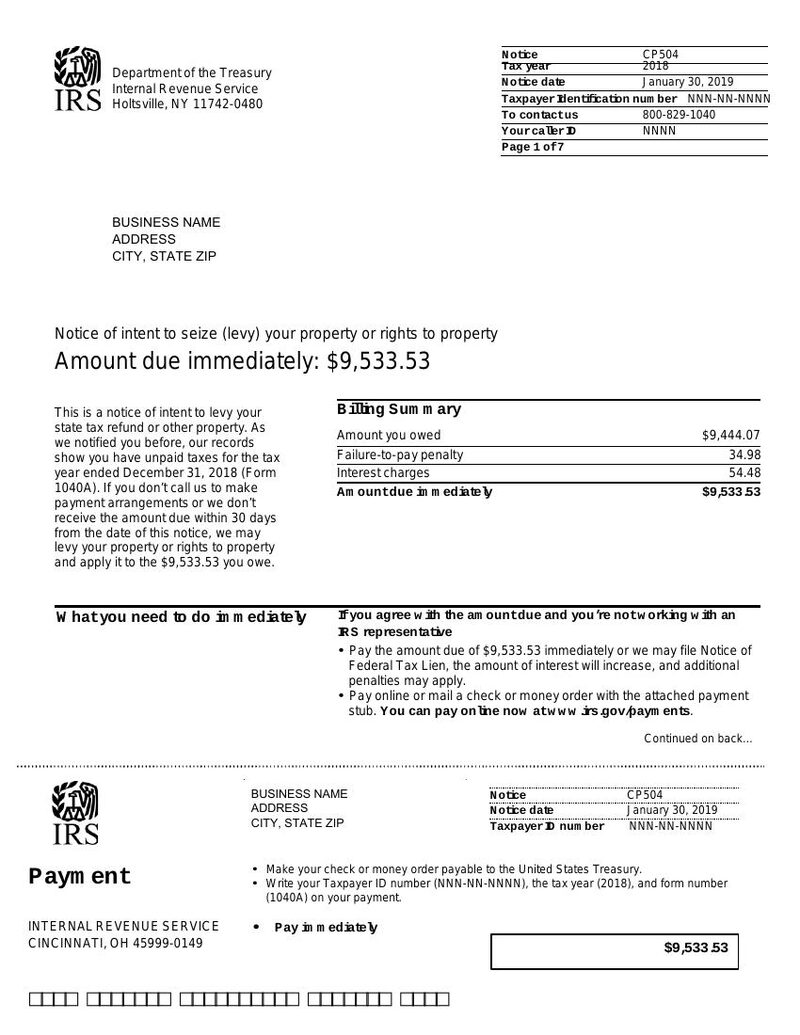
Why you got an IRS CP504
- You did not respond to earlier CP14, CP501, and CP503 notices.
- Your IRS account remains in active collection status with a balance due.
- A prior installment agreement defaulted and was not reinstated.
What happens if you ignore this notice
The IRS can seize your state tax refund, bank accounts, wages, and other property. This is serious.
How to respond to a CP504
Recommended completion window: within 30 days of the notice date
- 1
Stop the state refund seizure
Pay the balance, request an installment agreement, or get representation immediately. CP504 specifically authorizes seizing your state refund.
- 2
Request CDP rights when LT11 arrives
CP504 does not yet grant Collection Due Process rights for most assets. The LT11/Letter 1058 that follows does — and you have only 30 days to request the hearing.
- 3
File any unfiled returns
The IRS will not finalize most resolution paths (installment agreement, OIC, CNC) while you are out of filing compliance.
- 4
Submit Form 9465 or 433-A
Form 9465 requests an installment agreement; Form 433-A documents financial hardship. A CPA can file these on your behalf with Form 2848.
Common mistakes with a CP504
- Confusing CP504 with the final notice — LT11/Letter 1058 carries the CDP hearing rights, not CP504.
- Waiting until the IRS files a tax lien, which damages credit and complicates lending.
- Sending a partial payment without an active agreement — it doesn't stop collection escalation.
IRS forms referenced
Form 9465
Installment Agreement Request
View form detailsForm 433-A
Collection Information Statement (Individuals)
View form detailsForm 2848
Power of Attorney and Declaration of Representative
View form detailsForm 12153
Request for a Collection Due Process or Equivalent Hearing
View form details
Frequently asked questions about CP504
Will the IRS take my paycheck after a CP504?
+
Not yet from CP504 alone. Wage garnishment requires the IRS to first issue a Final Notice of Intent to Levy (LT11 or Letter 1058) and wait 30 days. CP504 does authorize seizure of your state refund and certain federal payments.
Does CP504 file a tax lien?
+
Not automatically. CP504 can lead to a Notice of Federal Tax Lien (NFTL), which the IRS files publicly to secure its position. Resolving the balance before the NFTL is filed protects your credit and lending options.
How long do I have to respond to a CP504?
+
About 30 days. After that, the IRS typically issues LT11 or Letter 1058 — the final notice before bank and wage levies.
Reviewed by Franklin Sofi, MBA, CPA, CTRS — Founder & Tax Resolution Specialist at Comprehensive Tax Resolution. Last reviewed November 2025.
This page is general information, not legal or tax advice. For specific guidance on your IRS notice, contact a qualified CPA or tax resolution specialist.