

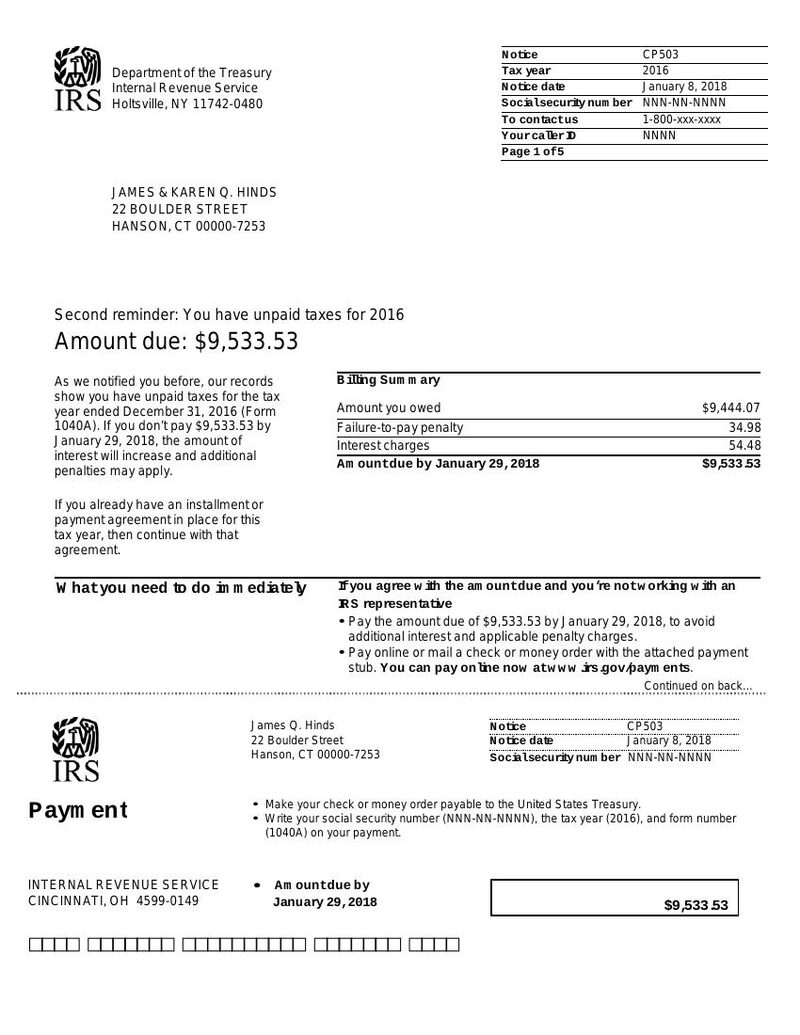
Why you got an IRS CP503
- You haven't responded to the earlier CP14 and CP501 notices.
- A prior payment plan defaulted without being reinstated.
- Penalties and interest have grown the balance since the original CP14.
What happens if you ignore this notice
The next notice (CP504) will threaten to seize your state tax refund and other assets.
How to respond to a CP503
Recommended completion window: within Immediate of the notice date
- 1
Treat this as urgent
The next notice (CP504) authorizes the IRS to take your state refund and certain federal payments. Don't wait.
- 2
Pay the full balance or request a payment plan
Streamlined installment agreements remain available for balances under $50,000. Larger balances need Form 433-A or 433-F.
- 3
If facing hardship, file for Currently Not Collectible status
CNC pauses collection while you cannot pay basic living expenses. Be ready to substantiate income, expenses, and assets.
- 4
Get representation if the balance is large or complex
A CPA or Certified Tax Resolution Specialist with a Form 2848 power of attorney can communicate with the IRS on your behalf.
Common mistakes with a CP503
- Assuming there's still time — CP504 typically follows within 5 weeks.
- Setting up a plan you can't actually afford, which leads to a CP523 default later.
- Failing to file unfiled returns first — the IRS will not finalize most resolution options until you are in filing compliance.
IRS forms referenced
Form 9465
Installment Agreement Request
View form detailsForm 433-A
Collection Information Statement (Individuals)
View form detailsForm 2848
Power of Attorney and Declaration of Representative
View form details
Frequently asked questions about CP503
What comes after a CP503?
+
CP504 (Notice of Intent to Seize State Refund), followed by LT11 or Letter 1058 (Final Notice of Intent to Levy — your last warning before bank and wage levies).
How long after a CP503 does the IRS issue CP504?
+
Typically about five weeks, but it varies by case and IRS workload. Don't rely on the gap — act immediately.
Can I still negotiate after a CP503?
+
Yes. Installment agreements, Offers in Compromise, and Currently Not Collectible status are all available. Earlier action means fewer accrued penalties and more leverage.
Reviewed by Franklin Sofi, MBA, CPA, CTRS — Founder & Tax Resolution Specialist at Comprehensive Tax Resolution. Last reviewed November 2025.
This page is general information, not legal or tax advice. For specific guidance on your IRS notice, contact a qualified CPA or tax resolution specialist.